
Airtable Templates for Shopify Sync
AirPower works with any Airtable base, but starting from a ready-made Airtable template is the fastest path to a working Shopify sync. Template bases include pre-built tables and columns that match AirPower’s default field mappings.
Three templates are available:
Expanded (Most popular) Multi-variant products and multi-location inventory. Includes: Products, Variants, Collections, Customers, Orders, Refunds.
Compact Single-variant products, simple inventory. Includes: Products, Inventory, Collections, Customers, Orders.
Wholesale Draft Order Form Enter wholesale orders in Airtable and push them to Shopify. Includes: Draft Orders, Customers, Products.
Use a template when creating a sync
- On the dashboard, click New sync
- Select Use one of our template bases
- Click Use template next to the template you want. This opens the template on Airtable Universe.
- On that page, click Use template again and save it to the workspace where AirPower is connected
- Return to AirPower and click I’ve added the template - Continue
- Select the base you just copied and click Use this base - Continue
The sync editor opens with the template base selected. For syncs created through the template path, AirPower pre-fills the template settings automatically when the editor opens.
Template auto-detection
When you select an existing Airtable base, AirPower checks whether its table and column names match a known template. If a match is found and the sync was not already auto-configured, a prompt appears at the top of the editor:
“Looks like you’re using an AirPower template.”
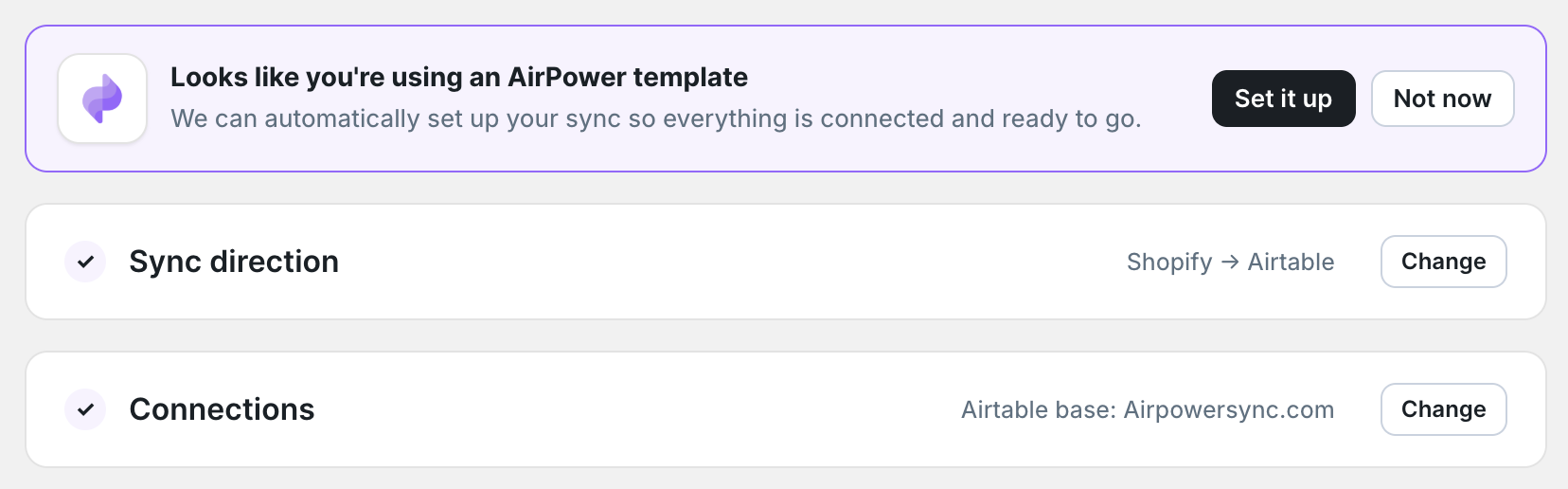
Set it up: applies the default field mappings for that template automatically. AirPower maps every column in the template to its corresponding Shopify field. No manual mapping is needed.
Not now: dismisses the prompt. You can configure field mappings manually in Data & fields.
Auto-detection also runs when you select an existing base that happens to match a template structure. If you already use an Expanded or Compact base, AirPower offers to apply the template setup even when the sync was not created through the template flow.
After automatic setup, a setup-complete notice appears. Review the settings, then click Save sync.