
Bulk Edit Shopify Product, Order, and Customer Tags in Airtable
In Shopify, tags label products, orders, and customers with free-form values that drive filtering, segmentation, and collection rules. Each record stores its tags as a comma-separated list.
Tagging in the Shopify admin is per record. Renaming a tag across hundreds of products, or adding a label to a segment of orders, means opening each record and editing the list by hand.
AirPower maps the tags field to an Airtable column on the Products, Orders, or Customers table. Edit values in bulk, or switch the column to Multi-Select for cleaner segmentation. When the sync runs, Shopify is updated.
Editing Shopify product tags
This example uses product tags. The same process applies to order and customer tags. Open the Airtable → Shopify sync, then open Data & fields. Click Products and confirm the tags field is mapped to an Airtable column.
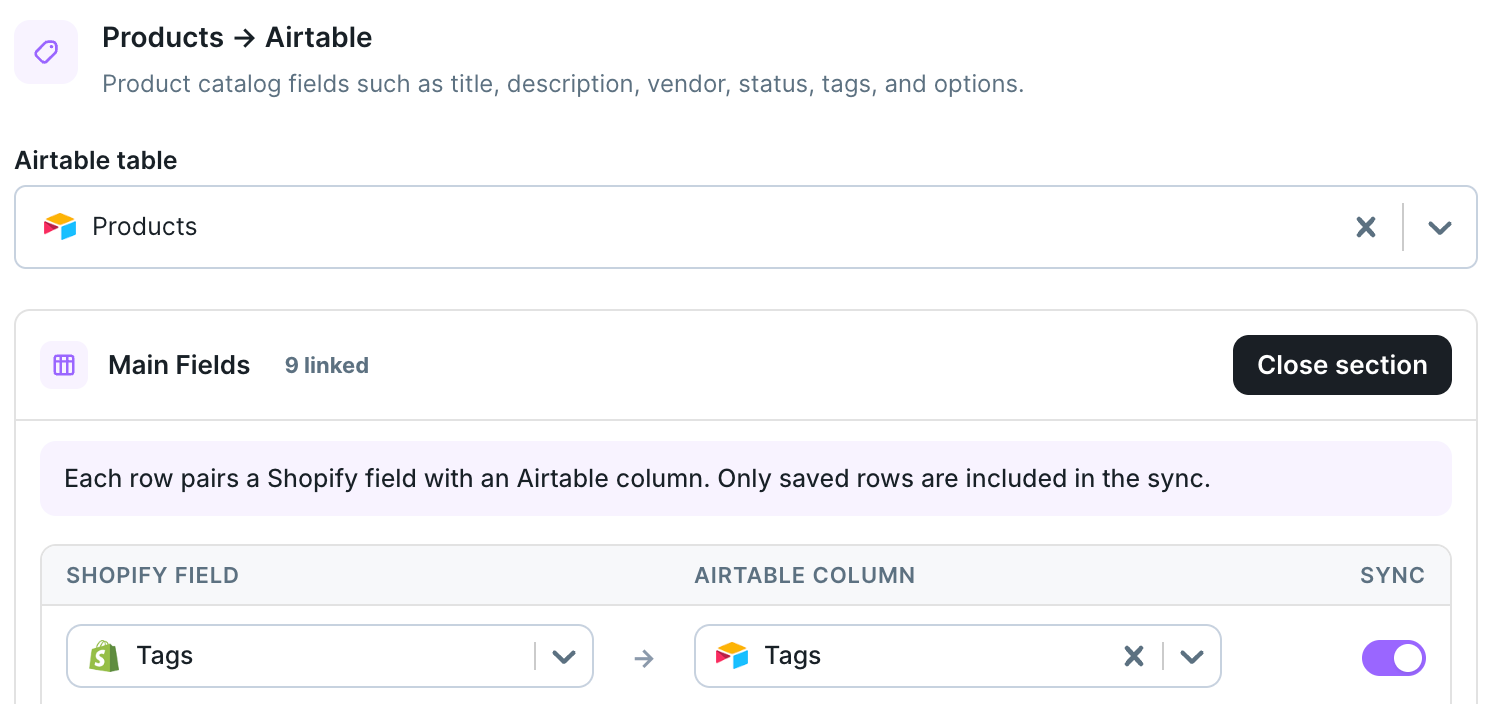
By default, Shopify stores tags as comma-separated words. For example - “best seller, new, trending”. That is how they will sync to/from Shopify, and that is the format which AirPower will send tags to Shopify when you activate an Airtable-to-Shopify sync. If the Airtable column is not a pure text column, but a Select or Multi-Select for example, AirPower will convert the values it receives from Airtable into the format Shopify needs.