
Bulk Edit Shopify Metafield Translations with Airtable
In Shopify, metafield values can be translated for each enabled language and, optionally, for specific markets. A French audience can see one care-instructions value, the Spanish market another, with the default value falling back when no translation exists.
Translating metafields in the Shopify admin happens one field, one language, one record at a time. For large catalogs across several locales, the editor becomes a bottleneck.
AirPower brings metafield translations into Airtable. Each language and market scope maps to its own column on the data type’s table. Edit translations in bulk, then push the changes back to Shopify. This is a separate mapping flow from standard field translations.
Metafield translations vs. translations
Translations maps translated values of standard Shopify fields: title, body HTML, handle, SEO fields, and other core fields that Shopify supports for translation.
Metafield translations maps translated values of metafields: custom fields you have defined for products, variants, collections, or other objects.
Both panes appear under the same data type in Data & fields, but each has its own mapping rows. Configure them independently based on what you need to translate.
Prerequisites
- The Shopify store has at least one additional language enabled. Markets appear as additional scope options when available.
- The Shopify store has metafield definitions available for the data type you are configuring
If no additional languages are enabled in Shopify, the pane shows a No additional languages available empty state.
Where the pane appears
The Metafield translations pane appears for configured data types where metafield definitions are available. It also appears whenever the sync already has metafield translation mappings on a data type.
To find it:
- Open the sync editor
- Go to Data & fields
- Click the data type (for example, Products)
- Find the Metafield translations pane in the editor
Translation scopes: All Markets vs. per-market
Each metafield translation is defined for a specific language, and the language can be either generic across markets or targeted at a single market.
All Markets
A generic translation for a language. Customers see this value in every market where that language is active, unless a market-specific translation overrides it.
A specific market
A translation that only customers in that market see. Use this to vary the metafield value for one market while keeping the All Markets value as the default.
The same metafield can be mapped under All Markets and under one or more market scopes at the same time.
Map a metafield translation
Rows in this pane are grouped by language and market scope. Add each translation under the scope it belongs to.
- Open the Metafield translations pane
- Find the card for the language and scope you want to translate. Use the All Markets card for a generic translation, or the per-market card to override for a single market.
- Click + Add a metafield translation inside that card
- Choose the metafield to translate
- Select the Airtable column to store the translated value
- Click Save sync
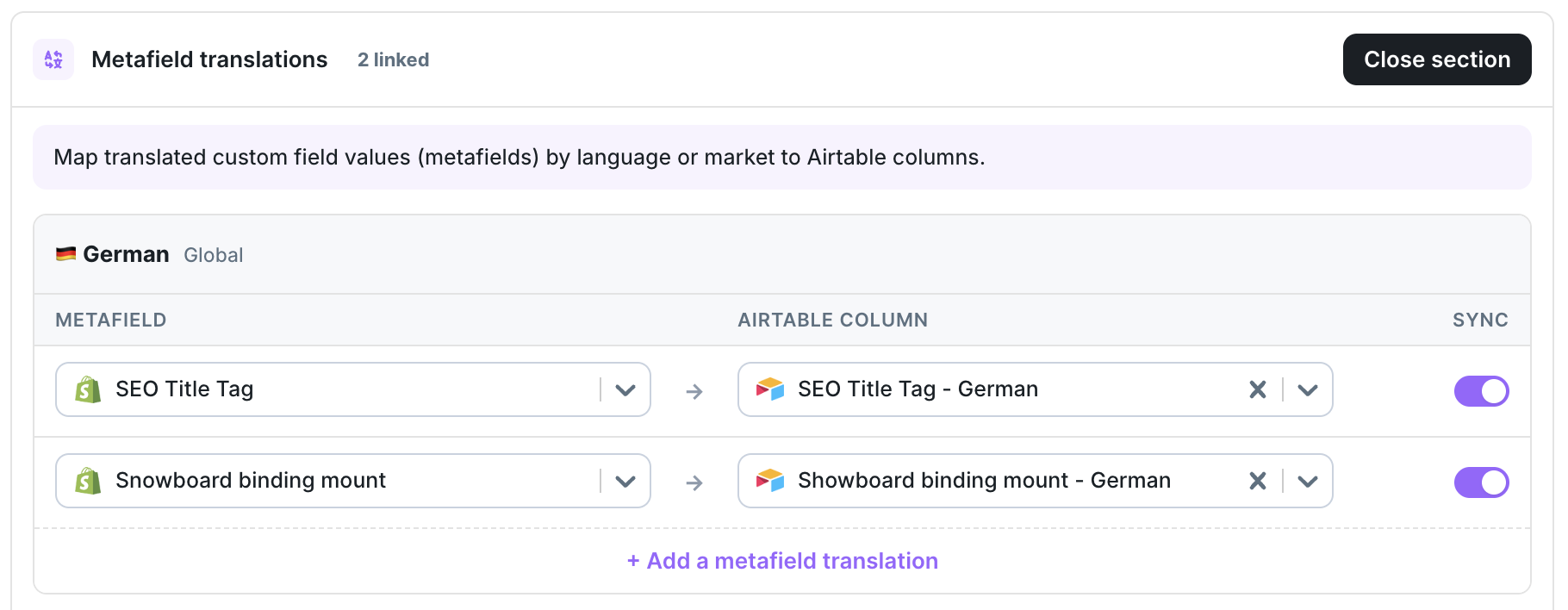
Each row maps a single metafield + scope combination to one Airtable column. To translate the same metafield into multiple languages or markets, add one row inside each relevant scope card.
Download metafield translations from Shopify
Translation changes are not pushed automatically from Shopify to Airtable. They require a manual pull.
From the dashboard sync card: Find the Sync manually section and click Translations. This downloads all translation data, both standard translations and metafield translations, for every configured object in the sync.
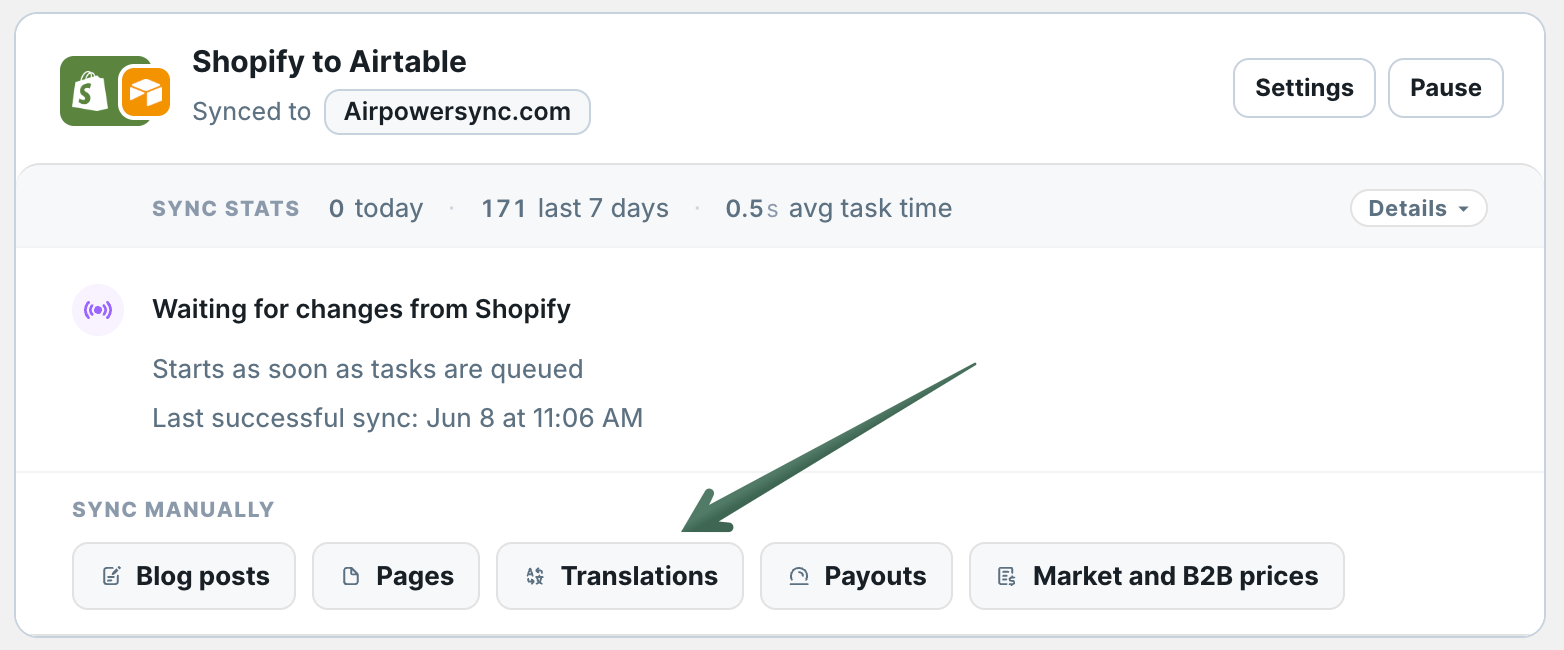
From the sync editor: Go to Settings → Download Shopify data → Translations → Download.
After the download completes, the mapped Airtable columns contain the current translated metafield values from Shopify.
Edit metafield translations in Airtable
Update the translated values directly in the mapped Airtable columns. Changes are not sent to Shopify until you run an Airtable → Shopify sync.
Push edits back to Shopify
- Open the Airtable → Shopify sync
- Go to Data & fields
- Click the same data type (for example, Products)
- Select the Airtable table that contains the records to update
- Open the Metafield translations pane
- Under each relevant locale or market scope, add a row that maps the same metafield to the matching Airtable column
- Click Save sync
- Click Sync now on the dashboard sync card
AirPower reads the mapped columns and writes the translated metafield values back to Shopify under the matching locale or market.
What you’ll see after saving
The Metafield translations pane shows each configured row with its metafield, locale or market, and the Airtable column it writes to. After running a download, the mapped columns are populated with translated metafield values. After a push, the updated values appear in the Shopify admin under the corresponding locale or market.