
Bulk Edit Shopify Orders and Order Line Items with Airtable
In Shopify, an order holds the high-level transaction: customer, totals, financial and fulfillment status, addresses, and notes. The order line items hold the per-SKU detail: which variant was bought, quantity, price, discounts, taxes, and any customer-entered properties.
Working with this in the Shopify admin means opening each order to see line detail. CSV exports help for one-off reports but are not a place to build live dashboards, custom workflows, or shared queues.
AirPower brings orders and line items into Airtable as two linked tables. Each line item row connects back to its parent order, and order rows connect to customers, companies, and locations when those are also configured. From there your team can build reconciliation views, fulfillment queues, and reports without re-exporting.
What Orders and Order Line Items contain
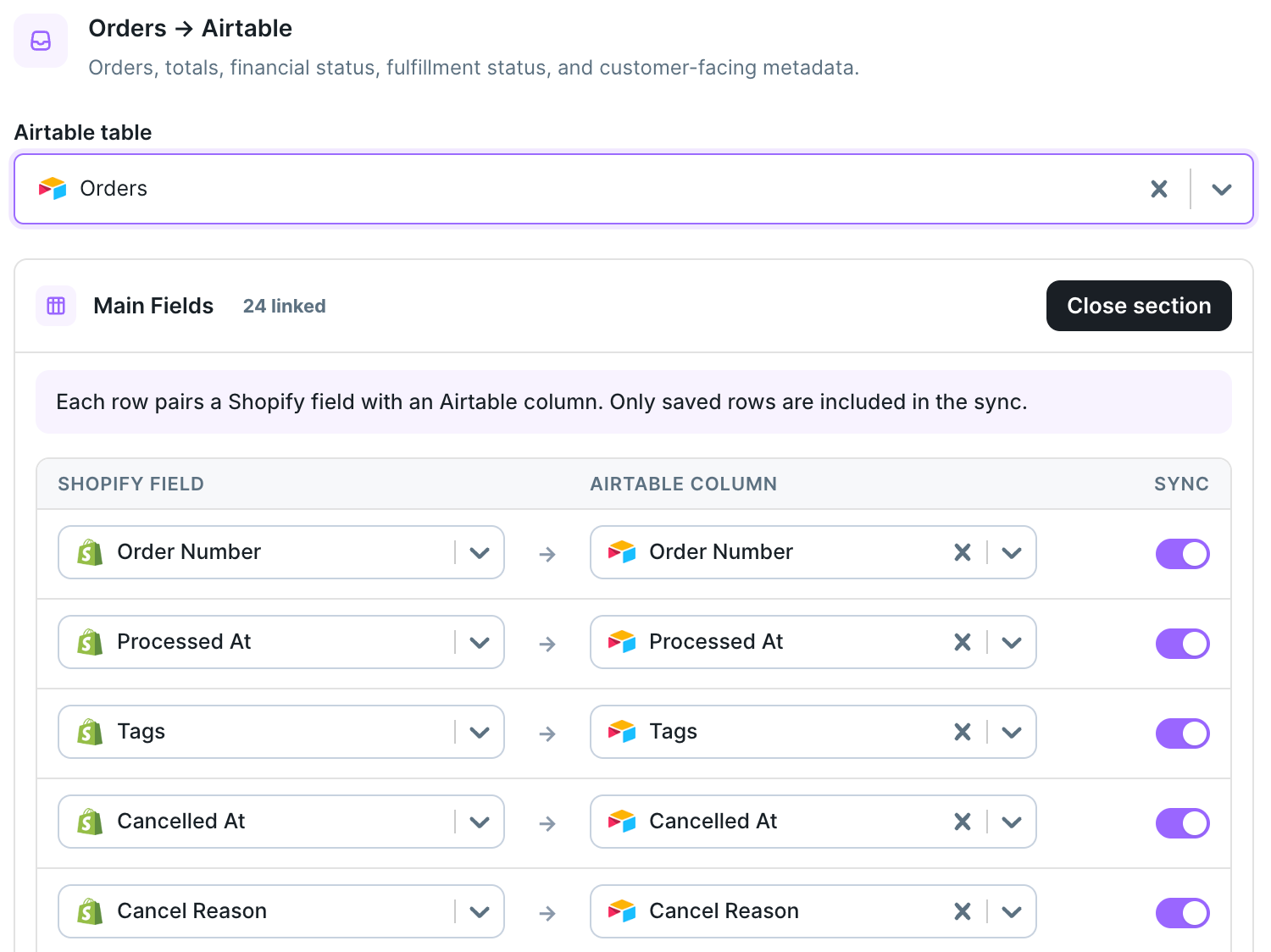
Orders hold order-level data. Fields that sync in both directions include name, note, and tags. Read-only fields pulled from Shopify include order number, source name, customer email, first name, last name, phone, customer tags, customer note, current subtotal price, current total price, current total tax, total discounts, total price, financial status, fulfillment status, presentment currency, processed at, created at, updated at, closed at, cancelled at, cancel reason, shipping address, billing address, shipping lines, fulfillment details, payment gateway names, payment terms, and Shopify IDs. Discount codes and discount applications are also available.
Order Line Items hold line-level data. They sync from Shopify into Airtable for order reporting, and they can also help build draft orders. Editing a line item on its own does not send the change back to Shopify. Mappable fields include SKU, quantity, price, title, vendor, name, taxable, total discount, fulfillable quantity, fulfillment service, fulfillment status, requires shipping, gift card, variant SKU, variant barcode, and custom property values. Additional fields available include variant ID, variant title, origin location details, discount allocations, and tax lines.
How the records link
When both Orders and Order Line Items are configured, line item rows link back to their parent order row. If Customers, Companies, or Company Locations are also configured, order rows can link to those records as well.
Set up Shopify → Airtable (download orders)
- Open or create a Shopify → Airtable sync
- In Connections, select your Airtable base
- Go to Data & fields
- Click Orders, select an Airtable table, and map fields in Main fields
- Click Order Line Items, select a separate Airtable table, and map fields in Main fields
- Click Save sync
- Go to Settings → Download Shopify data
- Set the Orders since date to choose how far back to load
- Click Download next to Orders
Order Line Items do not have a separate Download row. They load as part of order processing.
Once this initial backfill is done, Shopify order data continues to flow into Airtable automatically. New orders appear in the Orders table as they are placed, and existing order rows update whenever the order changes in Shopify, on the sync schedule.
Update orders from Airtable
Rows with a Shopify ID can push changes back to Shopify using an Airtable → Shopify sync. The most common editable fields are Note and Tags. Most order fields are read-only in Shopify after an order is placed.
To create orders, use Draft Orders instead. See Wholesale draft orders for details.
What you’ll see after saving
After the download completes, order rows appear in the Orders table and line item rows appear in the Order Line Items table, linked to their parent orders. Any sync errors appear on the dashboard sync card.