
Connect Related Airtable Tables with Linked-Record Columns
In Airtable, related data usually lives across multiple tables. Products and Variants sit in two tables connected by a column on the Variants table that points to the parent product. Orders, Customers, Line Items, and Fulfillments all relate the same way. The column that holds these references is called a linked-record column.
Shopify already knows these relationships, but Airtable does not learn them on its own. Without linked-record columns, a variant row has no way to find its product, and an order line item has no way to find its order.
AirPower wires this up for you. When a sync runs, it reads or writes linked-record columns automatically so related rows stay connected on both sides.
What is a linked-record column?
A linked-record column in Airtable is a column that points from one row to one or more rows in another table.
A simple example:
- You have a Products table with one row per product
- You have a Variants table with one row per SKU
- Each variant belongs to exactly one product
In Airtable, you create a column on the Variants table called Product that points to the matching row in the Products table. When you open a variant, you can click straight through to its parent product.
That column is a linked-record column. AirPower uses it to pass information back and forth between the two tables during a sync.
Why AirPower cares about linked-record columns
Shopify already knows that a variant belongs to a product. When AirPower pulls data from Shopify into Airtable, it has to translate that Shopify relationship into something Airtable can use: which is a linked-record column.
Going the other way, when you push changes from Airtable to Shopify, AirPower reads the linked-record column to resolve parent and related Shopify records, for example, finding a variant’s parent product, identifying the customer attached to a draft order, or linking an order line item back to its order.
So linked-record columns serve two purposes:
- Shopify → Airtable: AirPower fills the linked-record column so related rows are connected automatically in Airtable
- Airtable → Shopify: AirPower follows the linked-record column to resolve parent and related records when writing data back to Shopify
If a sync has multiple related data types but no linked-record columns between their tables, AirPower has no way to keep them properly connected.
How AirPower picks the right column
When you select an Airtable base, AirPower reads its structure: which tables exist, which columns each table has, and which columns are linked-record columns pointing at other tables.
For every pair of related data types you configure, AirPower checks the base for a linked-record column that connects the two tables and uses that column automatically. You do not need to set this up by hand if your base structure is straightforward.
This is called auto-detection. It runs whenever AirPower reloads the base metadata, for example, when you select or reload the base, configure a data type, or save after creating new tables or columns. AirPower does not detect Airtable schema changes on its own between those moments.
Common relationships AirPower recognizes
When both data types are configured in the same sync and your base has a linked-record column between their tables, AirPower will connect them. The relationships it recognizes include:
- Products ↔ Variants
- Products ↔ Collections
- Products ↔ Images
- Products ↔ Order Line Items
- Variants ↔ Images
- Orders ↔ Order Line Items
- Orders ↔ Customers
- Orders ↔ Companies
- Orders ↔ Company Locations
- Order Line Items ↔ Draft Orders
- Order Line Items ↔ Products
- Order Line Items ↔ Variants
- Order Transactions ↔ Orders
- Refunds ↔ Refund Line Items
- Refunds ↔ Orders
- Refund Line Items ↔ Order Line Items
- Draft Orders ↔ Customers
- Payouts ↔ Balance Transactions
- Balance Transactions ↔ Orders (recognized for configuration; not auto-populated by default)
- Fulfillments ↔ Orders
- Fulfillment Line Items ↔ Fulfillments
- Fulfillment Line Items ↔ Orders
- Fulfillment Line Items ↔ Order Line Items
- Blogs ↔ Blog Posts
- Companies ↔ Company Locations
If you only sync one of the two data types, the relationship is simply ignored.
Missing linked-record columns are created automatically
If two related Shopify data types are mapped to different Airtable tables and neither table already has a linked-record column connecting them, AirPower creates the column for you when you click Save sync. The new linked-record column appears in the correct Airtable table and is used for that relationship going forward.
This applies to any of the relationships listed above. You only need to confirm both data types are configured with an Airtable table selected. The linked-record column itself is added on save.
See and change the links AirPower is using
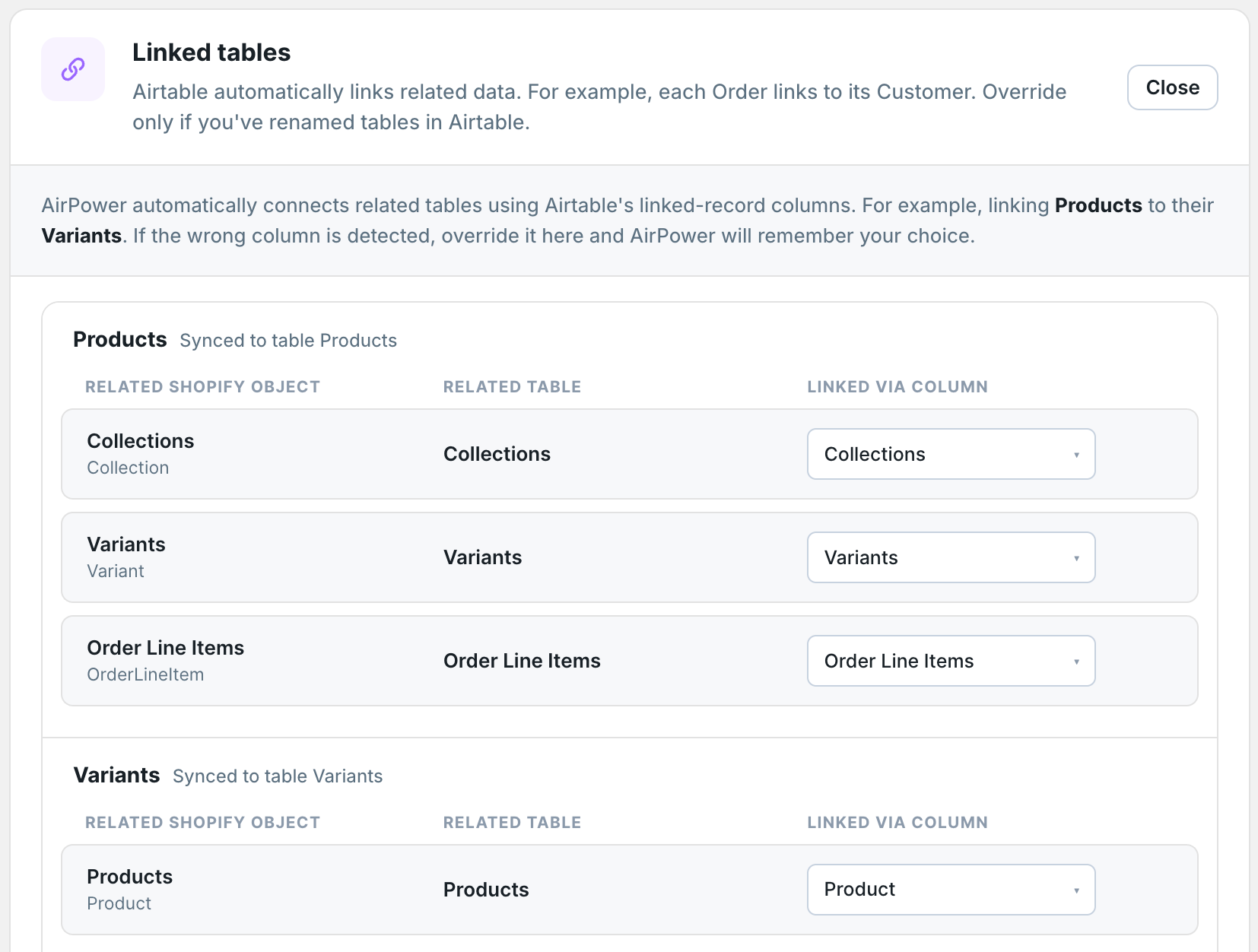
Each sync has a settings panel that shows every relationship it knows about and which Airtable column it is using for each one.
- Open a saved sync
- Scroll to Settings
- Find the Linked tables section
For each configured data type, the section shows:
- The related Shopify object (for example, Variants when looking at the Products row)
- The Airtable table that data type is mapped to
- The Airtable column being used to connect the two
When you might need to override a link
Most stores never need to change anything here. The defaults work as long as your base uses standard linked-record columns.
You might need to set the link manually when:
- You renamed a linked-record column to something AirPower doesn’t recognize
- Your base has more than one linked-record column between the same two tables, and AirPower picked the wrong one
- You added a new linked-record column after the base was first loaded
How to override a link
In the Linked tables section:
- Find the row for the relationship you want to change
- Use the dropdown in the Linked via column column
- Select the correct linked-record column
- Click Save sync to persist the change
A small Manually selected badge appears next to the row to remind you that auto-detection is not in charge of that link anymore.
To go back to automatic detection, open the dropdown again and choose Auto-detect, then click Save sync.
What you’ll see after saving
The next sync run uses the column you chose. The Linked tables section keeps showing your override along with the Manually selected badge until you switch it back to auto-detect.
If a relationship has no linked-record column available because the target table has not been created yet, the dropdown shows No linked-record columns found. Create the target table first (or let AirPower create it from the editor), then save the sync. The missing linked-record column is added on save.