
Filter Which Shopify Records Sync to Airtable
By default, a Shopify → Airtable sync pulls every record for the data types you configure. For most stores, that is more than they need in Airtable. You may want only active products, only orders from the last 90 days, or only customers that accept marketing.
Filtering rules narrow what comes through. Each rule checks a Shopify field, an operator, and a value. Records that match are included or excluded based on how you set up the rule group, so your Airtable base stays scoped to the data you actually work with.
Filtering requires AirPower Plus. It is available on these data types: Products, Images, Pages, Orders, and Customers.
Open the Filtering section
- Open a Shopify → Airtable sync
- Scroll to the Filtering section
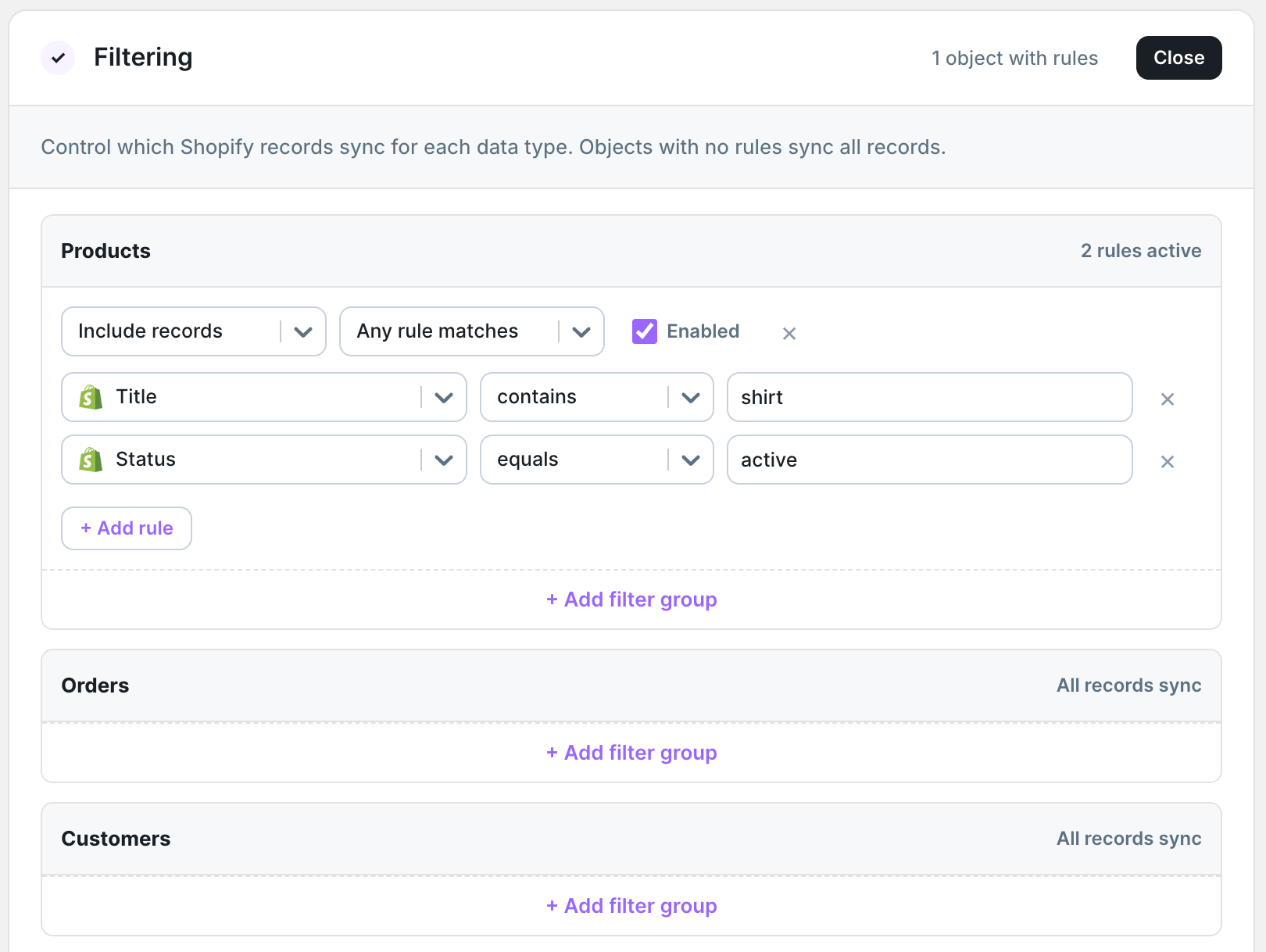
Each data type that is configured in Data & fields appears as a card. Data types with no rules show “All records sync.”
Add a filter group
- Find the data type you want to filter (for example, Products)
- Click + Add filter group
- Set the group to Include records or Exclude records
- Set the matching logic to Any rule matches (OR) or All rules match (AND)
- Configure the first rule: choose a Shopify field, an operator, and a value
- Click + Add rule to add more conditions to the same group
- Click Save sync
Include records: only records matching the rule group are synced.
Exclude records: records matching the rule group are skipped; everything else syncs.
Available operators
- equals: exact match
- contains: the field value includes the text
- does not contain: the field value does not include the text
- greater than: numeric or date comparison
- less than: numeric or date comparison
Using more than one filter group
Most data types only need one filter group. A data type can have more than one, but it helps to understand how they work together first.
Each group makes its own decision about a record:
Include group Keeps the record when it matches the group. Drops it when it does not.
Exclude group Drops the record when it matches the group. Keeps it when it does not.
A record matches a group based on the group’s own rule logic, set by Any rule matches or All rules match.
When a data type has more than one group, AirPower checks them in the order they appear, and each group’s decision replaces the one before it. The last group that has rules is the one that decides whether the record syncs. For predictable results, keep a single group per data type unless you have a specific reason to chain them.
To pause a group without losing it, untick Enabled in the group header. The group stops affecting the sync but stays set up, so you can switch it back on later.
Data types not yet configured
If a data type has not been added in Data & fields, its card shows “Add this data type in Data & fields to configure filters.” Configure the data type first, then return to set up filters.
AirPower Plus requirement
If your plan does not include Plus, the Filtering section shows an upgrade prompt. Click Upgrade to AirPower Plus to unlock filtering.