
Bulk Edit Shopify Pages with Airtable
Shopify Pages hold the static, non-blog content on your storefront: About, Contact, Shipping, refund policy, FAQ, and the like. Each page carries a title, a handle, body HTML, an author, a publish date, and an optional template suffix.
Editing pages in the Shopify admin means opening one rich-text editor at a time. For coordinated policy updates, SEO refreshes, or copy reviews across many pages, that gets in the way.
AirPower brings pages into Airtable as rows. Edit body HTML, titles, handles, and other fields in a grid or through Airtable views, then push the updates back to Shopify on the next sync.
Pages support both Shopify → Airtable and Airtable → Shopify syncs. They also support the Translations pane for multilingual content.
Set up Pages
- Open a sync or create a new one
- In Connections, select your Airtable base
- Go to Data & fields
- Click Pages
- Select the Airtable table to sync to or from
- Open the Main Fields pane and map the fields you want to sync
- Click Save sync
Default mappable fields include title, handle, author, body HTML, template suffix, published at, created at, updated at, and store URL.
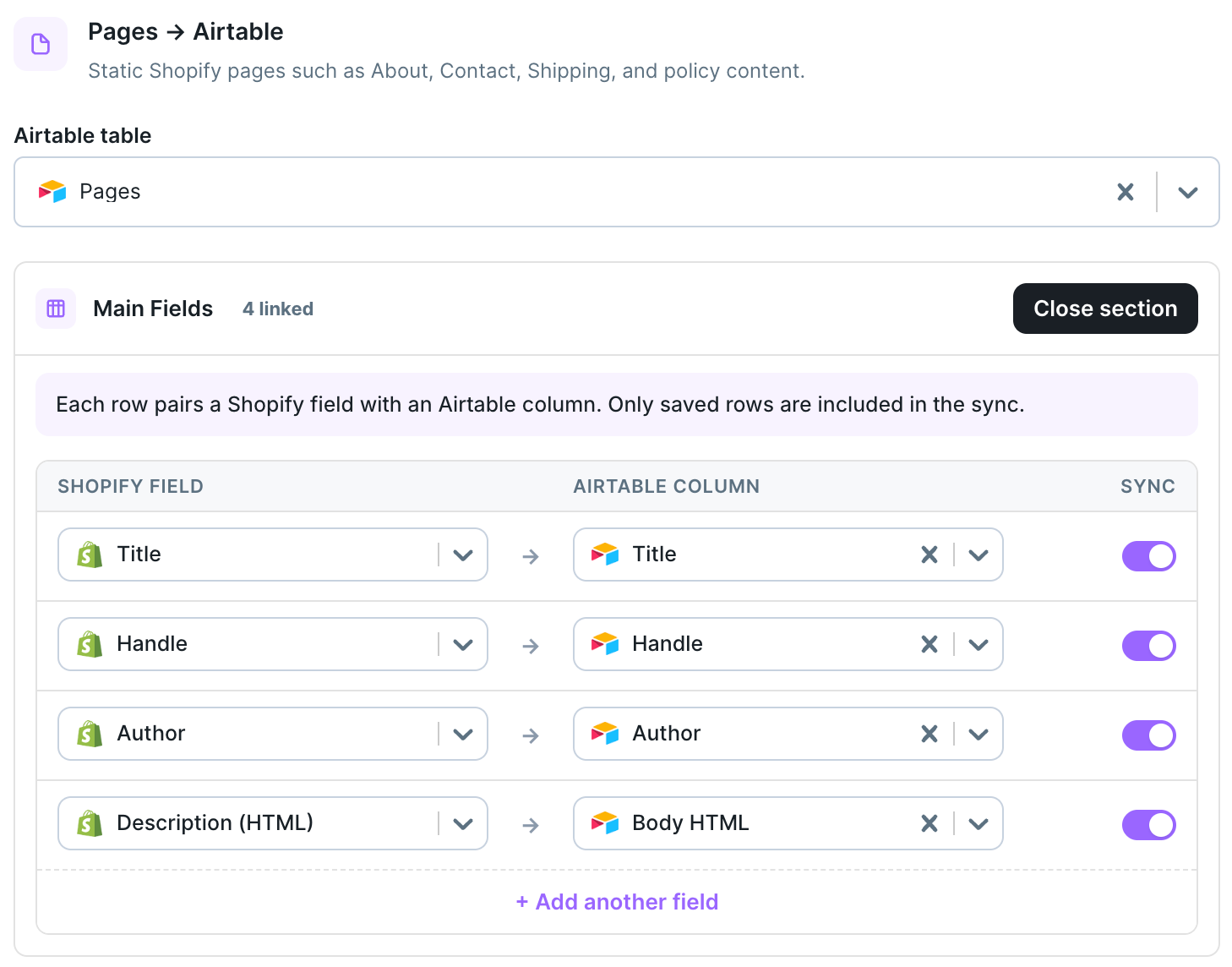
Pull pages from Shopify
Pages do not flow into Airtable automatically. They require a manual pull.
On the Shopify → Airtable sync card, find the Sync manually section and click Pages.
You can also trigger this from the sync editor: go to Settings → Download Shopify data, then click Download next to Pages.
Edit pages in Airtable
Update the mapped columns directly in the table. Use a long-text Airtable column for the body HTML field. Edits stay in Airtable until you run an Airtable → Shopify sync.
Push edits back to Shopify
- Open the Airtable → Shopify sync
- In Connections, select your Airtable base
- Go to Data & fields and confirm Pages is configured with the correct table and field mappings
- Click Save sync
- Click Sync now on the dashboard sync card
AirPower updates the page content in Shopify for each row that has a Shopify ID. Rows without a Shopify ID can create new pages when the required fields are present.
Translations
Pages support the Translations pane for syncing translated field values by language locale or market. See Bulk Edit Shopify Translations and Metafield Translations for setup steps.